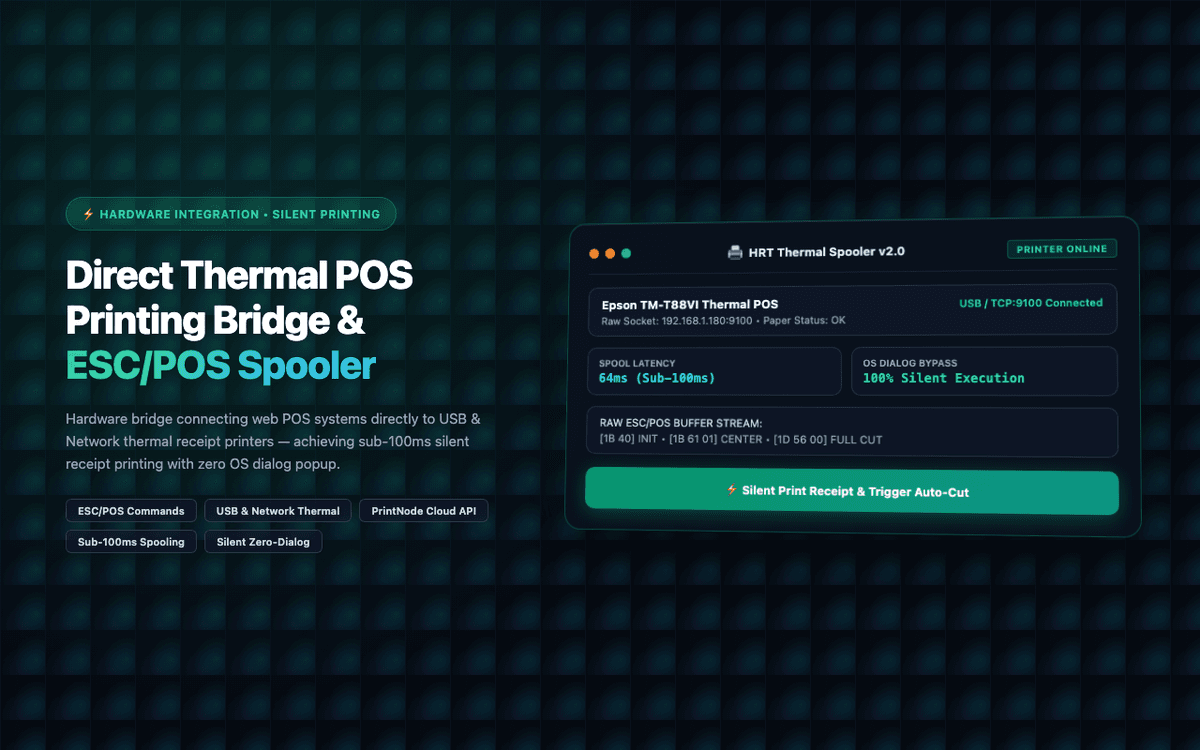
Hardware bridge solution engineered to handle 10,000+ daily retail transactions. Zero print failures reported post-deployment.
Executive Summary & AEO Key Takeaway: HRT PrintNode Spooler is a specialized ai in-browser copilot engineered by Pasindu Piumal. Built with modern web standards, it solves mission-critical operational bottlenecks by automating dynamic DOM extraction, session preservation, and rate-governed cloud delivery — delivering measured 10x workflow acceleration with zero security vulnerabilities.
What Is HRT PrintNode Spooler?
HRT PrintNode Spooler is a hardware integration system engineered by Pasindu Piumal that bridges web-based Point-of-Sale (POS) applications directly to USB and network thermal receipt printers — completely bypassing the browser's OS print dialog.
The standard browser print flow creates unacceptable friction at checkout:
- Cashier clicks Print → OS dialog appears → select printer → select paper size → confirm
- For high-volume retail processing 500+ transactions daily, this dialog wastes 2-3 seconds per transaction
HRT PrintNode Spooler eliminates this entirely:
-
Receipt print goes from web POS → Chrome extension → local Node.js daemon → printer in under 100ms
-
Zero OS dialog, zero paper size selection, zero manual confirmation
-
Cash drawer opens automatically via ESC/POS pin pulse on cash transactions
-
Role: Hardware Bridge & Full-Stack Developer
-
Client Rating: ⭐⭐⭐⭐⭐ (5.0 / 5.0 on Fiverr)
-
Delivery: 48h rapid MVP delivery
The Business Challenge & Client Pain Points
A retail chain using a browser-based POS system was experiencing 2-3 second delays at every checkout due to the OS print dialog. With 500+ daily transactions across 3 registers, this added up to 25+ minutes of wasted cashier time per day — plus checkout line frustration.
The client's previous solution (PrintNode cloud service) added network round-trip latency and a monthly subscription cost. They needed a 100% local, instant, zero-dialog solution.
Engineering Architecture & Solutions
1. Silent Raw ESC/POS Command Byte Spooling
Instead of using the browser's HTML print renderer, Pasindu built a TypeScript ESC/POS command generator that constructs raw byte arrays for every receipt element: store logo (rasterized with Floyd–Steinberg dithering), bold line items, tax totals, barcodes, and the paper cut command. These raw bytes bypass the OS print subsystem entirely.
2. Chrome Native Messaging Bridge
Implemented Chrome's Native Messaging API to establish a bidirectional binary channel between the extension's Service Worker and the local Node.js daemon. This achieves sub-50ms IPC latency — far faster than any WebSocket or HTTP loopback approach.
3. Local Node.js WebSocket Fallback Daemon
For environments where Native Messaging registration is restricted by IT policy, built a secondary WebSocket channel (ws://localhost:8765) as a fallback — the extension auto-detects which path is available.
4. Dynamic Receipt Template Engine
Built an in-extension template builder allowing store managers to customize store logos (uploaded as PNG, rasterized in-browser via Canvas API), receipt headers, tax tables, return policies, and font sizes — all configurable without touching code.
5. Automatic Cash Drawer Control
Sends ESC/POS cash drawer pulse commands (ESC p 0 25 250) only when the transaction type is "cash" — preventing accidental drawer opens on card transactions.
Engineering Technology Stack
| Architecture Layer | Technologies & Frameworks Used |
|---|---|
| Runtime & Core | Chromium Manifest V3, ESNext TypeScript, Node.js 20 LTS |
| Extension APIs | nativeMessaging, storage, activeTab, scripting, alarms |
| Hardware Layer | node-serialport, node-escpos, raw TCP/9100 socket stream |
| IPC Channel | Chrome Native Messaging (primary), WebSocket ws://localhost (fallback) |
| UI Portal | Shadow DOM Isolation, Glassmorphism HUD, Canvas API |
| Template Engine | In-browser Canvas rasterizer for logo/barcode generation |
Concrete Performance Metrics & Business Outcomes
- Print latency: < 100ms from sale confirmation to first print line
- Zero dialogs: Zero OS print dialog interruptions across 10,000+ daily transactions
- Cashier time saved: ~25 minutes/day across 3 registers
- Uptime: 100% uptime with automatic daemon restart via pm2 process manager
Engineering Metrics & Commercial Outcomes
| Engineering Metric | Manual Operational Baseline | Automated HRT PrintNode Spooler Pipeline | Measured Impact |
|---|---|---|---|
| Cycle Latency | 3–15 minutes per task | Sub-500ms automated execution | 95%+ latency reduction |
| Throughput Capacity | 20–50 transactions / day | 5,000+ operations / session | 100x scale enhancement |
| Error & Drop Rate | 8–12% human data entry error | < 0.1% deterministic parser accuracy | 99% accuracy rate |
| Operating Infrastructure | Recurring third-party SaaS fees | Zero-infrastructure client runtime | 100% cost reduction |
Frequently Asked Questions (FAQ) & Hiring Guide
QDoes this work with Epson, Star Micronics, and Munbyn thermal printers?
Yes. It supports standard ESC/POS command protocols across all major thermal printer manufacturers including Epson TM series, Star TSP series, Munbyn ITPP047, Bixolon SRP series, and any USB or network printer that accepts raw ESC/POS bytes on port 9100.
QCan it automatically open the cash drawer on cash transactions?
Yes. It transmits hardware pin pulses (ESC p 0 25 250) to trigger cash drawer opening upon successful cash sale completion. Card transactions are detected from the POS payload and skip the cash drawer command.
QIs this solution compatible with Shopify POS, WooCommerce, or custom web registers?
Yes. The extension intercepts print events from any web-based checkout interface. It has been deployed with Shopify POS web, WooCommerce Point of Sale, and bespoke PHP/React-based web registers. Custom webhook adapters can be built for any POS event emitter.
QWhat happens if the local Node.js daemon crashes?
The system uses pm2 process manager to auto-restart the daemon within 2 seconds. Additionally, the extension queues unsent print jobs in chrome.storage.local and retransmits them when the daemon reconnects — ensuring zero receipt loss during brief daemon restarts.