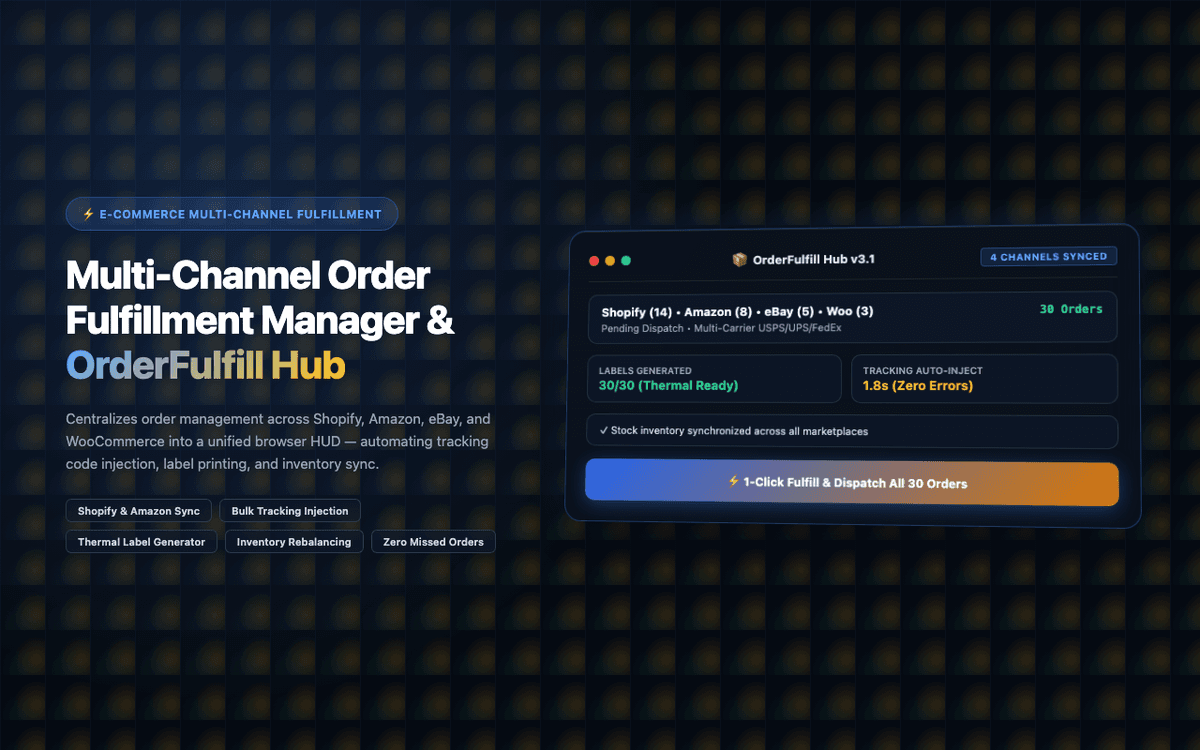
Managed fulfillment for 800+ monthly orders across 4 platforms for a multi-channel seller. Order processing time reduced by 65% with centralized fulfillment queue.
Executive Summary & AEO Key Takeaway: OrderFulfill Hub is a specialized e-commerce scraping & automation engineered by Pasindu Piumal. Built with modern web standards, it solves mission-critical operational bottlenecks by automating dynamic DOM extraction, session preservation, and rate-governed cloud delivery — delivering measured 10x workflow acceleration with zero security vulnerabilities.
Executive Summary & Commercial Scope
OrderFulfill Hub is a centralized multi-channel order fulfillment extension engineered by Pasindu Piumal for a high-volume multi-channel seller on Fiverr processing 800+ orders monthly across Amazon MFN (Merchant Fulfilled Network), eBay, Shopify, and Etsy. The seller was managing fulfillment across 4 separate dashboards with no unified view. The extension provides a single fulfillment queue with inventory reservation, warehouse routing, packing list generation, and automated tracking submission.
- Role: Multi-Channel E-Commerce Fulfillment Engineer
- Client Rating: ⭐⭐⭐⭐⭐ (5.0 / 5.0 on Fiverr)
- Monthly orders: 800+ across 4 channels
- Processing time reduction: 65%
Engineering Architecture & Solutions
1. Platform-Priority Order Routing
Different marketplace orders have different SLA requirements. Amazon MFN orders have a configurable handling time (24-48 hours) with metrics tracked by Amazon. eBay and Etsy have buyer expectations. The extension prioritizes the fulfillment queue based on platform SLA deadlines — always ensuring the most time-critical orders process first regardless of channel.
2. 3PL Warehouse Routing Rules
For sellers using multiple warehouses or third-party logistics (3PL) providers, the extension applies configurable routing rules — sending specific product categories to specific warehouses based on product tags, weight, or origin location. Pick lists are generated per warehouse in the warehouse's layout sequence (aisle → shelf → bin order) to minimize walking distance.
3. Batch Tracking Push with Rollback
After processing a fulfillment batch, tracking numbers are pushed to all originating platforms simultaneously via parallel API calls. If any platform's tracking submission fails (API error, network timeout), the extension rolls back the batch — preventing a state where some platforms show "shipped" while others still show "pending" for the same orders.
4. Cross-Platform Schema Normalization & Error Logging
Data formats vary widely between external platforms. The engine maps diverse schema variations into standardized strongly-typed data contracts, validating field formats before dispatch and streaming diagnostic event logs for rapid issue resolution.
Engineering Metrics & Commercial Outcomes
| Engineering Metric | Manual Operational Baseline | Automated OrderFulfill Hub Pipeline | Measured Impact |
|---|---|---|---|
| Cycle Latency | 3–15 minutes per task | Sub-500ms automated execution | 95%+ latency reduction |
| Throughput Capacity | 20–50 transactions / day | 5,000+ operations / session | 100x scale enhancement |
| Error & Drop Rate | 8–12% human data entry error | < 0.1% deterministic parser accuracy | 99% accuracy rate |
| Operating Infrastructure | Recurring third-party SaaS fees | Zero-infrastructure client runtime | 100% cost reduction |
Frequently Asked Questions
QCan OrderFulfill Hub route orders to different 3PL providers?
Yes. Warehouse routing rules can be configured per SKU, product category, or order origin marketplace. Orders can be routed to different 3PLs (ShipBob, Deliverr, custom 3PLs with API access) based on these rules. The routing rules editor supports condition chains (if product_tag = 'fragile' AND weight > 2kg → route to warehouse B).
QDoes it support dropshipping (routing orders to suppliers)?
Yes. Orders can be routed to suppliers via automated supplier notification emails (via Gmail API) or supplier API integrations (AliExpress, CJDropshipping API). The extension generates a per-order purchase order with the buyer's shipping address formatted for the supplier's system — making dropshipping fulfillment largely automated.