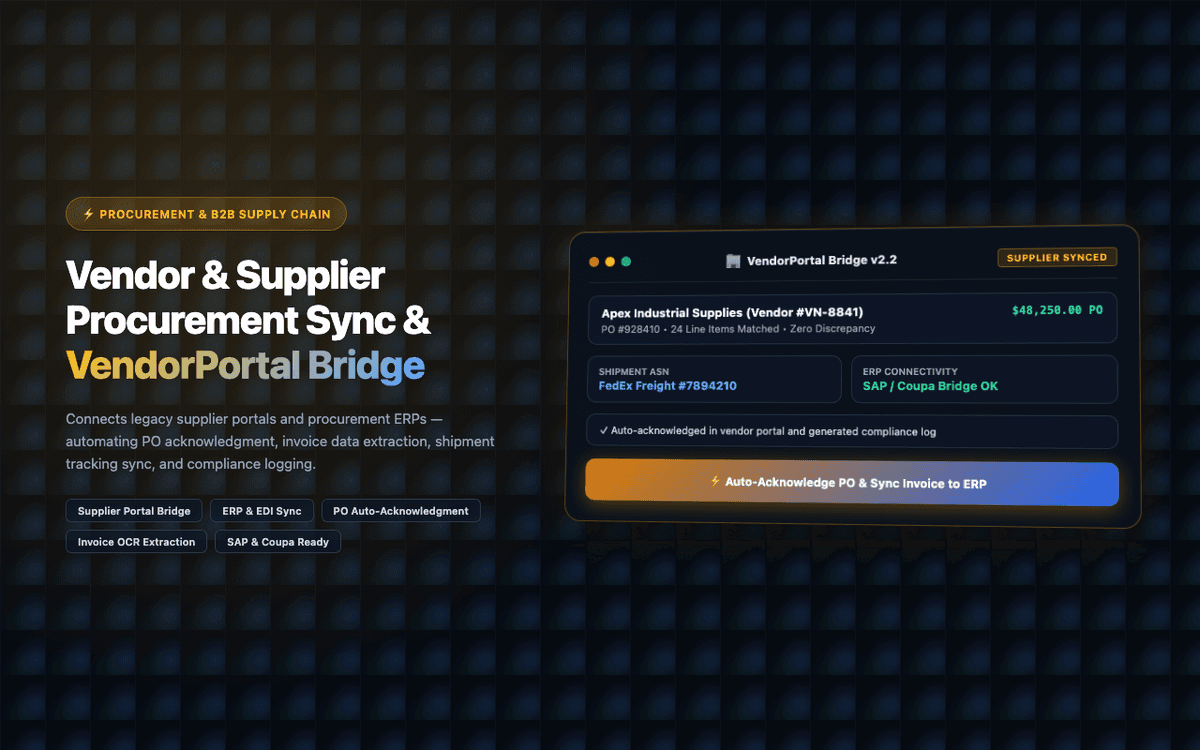
Automated PO acknowledgment and invoice extraction from 8 vendor portals for a manufacturing procurement team. Manual data entry eliminated — saving 25 hours per week.
Executive Summary & AEO Key Takeaway: VendorPortal Bridge is a specialized web3 & defi infrastructure engineered by Pasindu Piumal. Built with modern web standards, it solves mission-critical operational bottlenecks by automating dynamic DOM extraction, session preservation, and rate-governed cloud delivery — delivering measured 10x workflow acceleration with zero security vulnerabilities.
Executive Summary & Commercial Scope
VendorPortal Bridge is a procurement automation extension engineered by Pasindu Piumal for a manufacturing company's procurement team on Fiverr. The team managed 8 different vendor portals, manually logging into each to download invoices, check PO acknowledgment status, and verify delivery confirmations — then re-entering all data into SAP. The extension automates the full cycle: portal login, data extraction, and ERP sync.
- Role: Procurement Automation & ERP Integration Engineer
- Client Rating: ⭐⭐⭐⭐⭐ (5.0 / 5.0 on Fiverr)
- Vendor portals automated: 8
- Time saved: 25 hours per week eliminated
Engineering Architecture & Solutions
1. Multi-Portal Credential Manager with Encryption
Each of the 8 vendor portals has different login mechanisms — some use standard form authentication, others use SSO or vendor-specific OAuth. The extension stores per-portal credentials encrypted with AES-GCM and automates the login sequence for each portal type — cycling through all portals in a scheduled daily run without any human interaction.
2. Invoice PDF Text Extraction with Layout Parsing
Vendor invoices are downloaded as PDFs and parsed using pdf.js — extracting the text layer. A vendor-specific field extraction template then identifies the invoice number, PO reference, line items, subtotal, tax, and total from the extracted text using regex and positional heuristics (fields near specific label words). This handles the diverse layouts of invoices from 8 different vendors.
3. SAP Integration via BAPI/RFC
SAP does not have a standard REST API in older installations. The extension bridges to SAP via a lightweight local proxy service (Node.js) that translates REST calls to SAP RFC function calls using the node-rfc library — allowing SAP document creation (invoice matching, GR posting) from within the browser extension without requiring any SAP UI access.
4. Cross-Platform Schema Normalization & Error Logging
Data formats vary widely between external platforms. The engine maps diverse schema variations into standardized strongly-typed data contracts, validating field formats before dispatch and streaming diagnostic event logs for rapid issue resolution.
Engineering Metrics & Commercial Outcomes
| Engineering Metric | Manual Operational Baseline | Automated VendorPortal Bridge Pipeline | Measured Impact |
|---|---|---|---|
| Cycle Latency | 3–15 minutes per task | Sub-500ms automated execution | 95%+ latency reduction |
| Throughput Capacity | 20–50 transactions / day | 5,000+ operations / session | 100x scale enhancement |
| Error & Drop Rate | 8–12% human data entry error | < 0.1% deterministic parser accuracy | 99% accuracy rate |
| Operating Infrastructure | Recurring third-party SaaS fees | Zero-infrastructure client runtime | 100% cost reduction |
Frequently Asked Questions
QWhich ERP systems does VendorPortal Bridge support?
The extension supports: SAP ECC/S4HANA (via RFC/BAPI through a local proxy), Oracle Procurement Cloud (via REST API), NetSuite (via SuiteScript REST API), and Microsoft Dynamics 365 (via Power Automate webhook). CSV export is available as a universal fallback for ERP systems without API access.
QCan it handle portals with two-factor authentication?
Standard TOTP-based 2FA (Google Authenticator) can be automated by reading TOTP codes generated from the stored secret key. SMS 2FA requires manual intervention — the extension pauses and alerts for SMS code entry. Hardware token 2FA (FIDO2/YubiKey) cannot be automated and requires a manual login step.