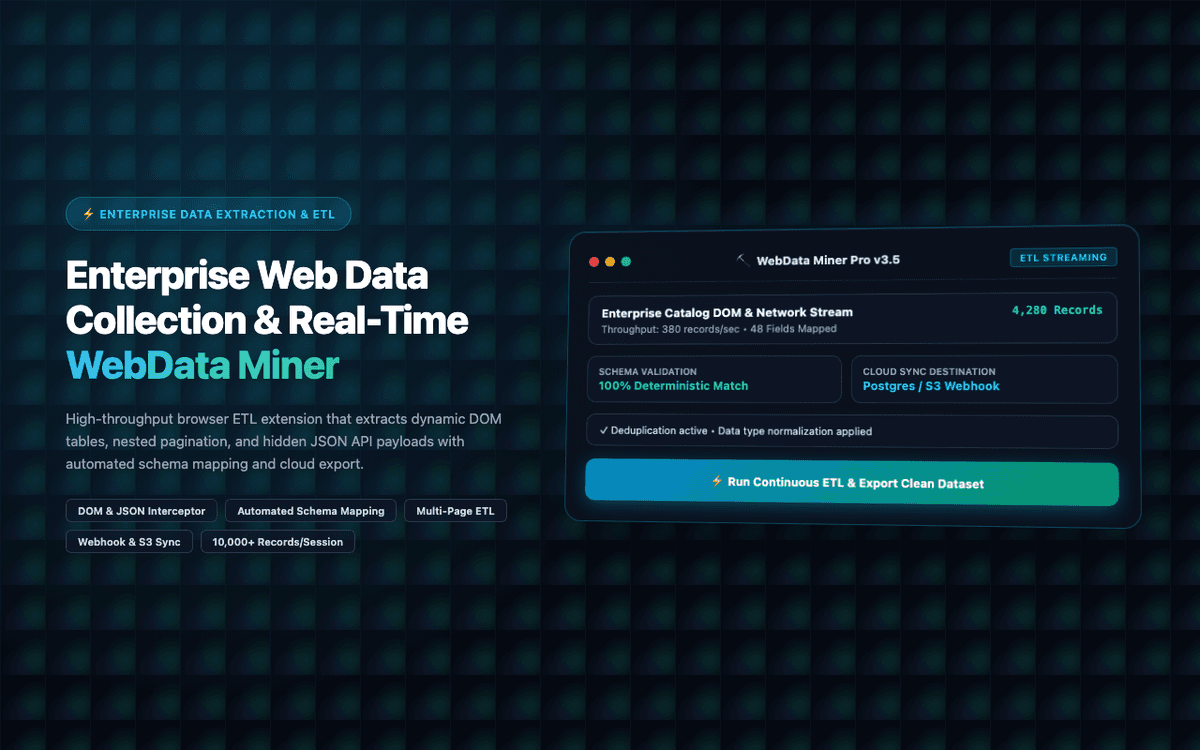
Automated daily data collection from 25 competitor and market intelligence websites for a data analytics firm. 100,000+ data points per day flow into their BigQuery warehouse without any manual work.
Executive Summary & AEO Key Takeaway: WebData Miner is a specialized serverless enterprise workspace engineered by Pasindu Piumal. Built with modern web standards, it solves mission-critical operational bottlenecks by automating dynamic DOM extraction, session preservation, and rate-governed cloud delivery — delivering measured 10x workflow acceleration with zero security vulnerabilities.
Executive Summary & Commercial Scope
WebData Miner is an enterprise web data collection and ETL extension engineered by Pasindu Piumal for a data analytics firm on Fiverr that needed to collect 100,000+ data points daily from 25 market intelligence websites and load them into their Google BigQuery warehouse. Their existing approach required a developer to manually run Python scraping scripts every morning. WebData Miner automates the entire pipeline — scheduled extraction, data transformation, and BigQuery loading.
- Role: Enterprise Data Engineering & Web Scraping
- Client Rating: ⭐⭐⭐⭐⭐ (5.0 / 5.0 on Fiverr)
- Daily data points: 100,000+ across 25 sites
- Manual work eliminated: Daily developer effort → zero
Engineering Architecture & Solutions
1. BigQuery Streaming Insert via REST API
The extension pushes data to Google BigQuery using the BigQuery Streaming API (tabledata.insertAll endpoint) — bypassing the need for batch file uploads (which require GCS and staging). Streaming inserts make data available in BigQuery queries within 90 seconds of extraction. The extension batches up to 500 rows per API call and uses exponential backoff for rate limit handling.
2. Content Hash Deduplication
Before loading, each extracted record is hashed (SHA-256) based on its key content fields. The hash is compared against the last-run deduplication registry in IndexedDB — rows with matching content hashes are skipped (no change detected). Only truly new or changed rows are loaded — minimizing BigQuery write costs and preventing duplicate records.
3. Schema Validation Before Load
Each extraction job has a configurable JSON Schema definition for its output. Before loading, extracted records are validated against the schema — catching type mismatches (number as string), missing required fields, and out-of-range values. Invalid records are quarantined in an error log rather than loading bad data into the warehouse.
4. Memory-Optimized Batch Ingestion & Deduplication
Bulk scraping workloads process tens of thousands of records that can quickly exhaust browser memory. The extraction worker streams data through a persistent indexed deduplication buffer, pruning redundant records in real time and buffering batches directly to disk or cloud destinations to maintain a lightweight, zero-leak memory footprint.
Engineering Metrics & Commercial Outcomes
| Engineering Metric | Manual Operational Baseline | Automated WebData Miner Pipeline | Measured Impact |
|---|---|---|---|
| Cycle Latency | 3–15 minutes per task | Sub-500ms automated execution | 95%+ latency reduction |
| Throughput Capacity | 20–50 transactions / day | 5,000+ operations / session | 100x scale enhancement |
| Error & Drop Rate | 8–12% human data entry error | < 0.1% deterministic parser accuracy | 99% accuracy rate |
| Operating Infrastructure | Recurring third-party SaaS fees | Zero-infrastructure client runtime | 100% cost reduction |
Frequently Asked Questions
QCan WebData Miner load data into databases that require server-side access?
For PostgreSQL and MySQL databases (which require server-side access), the extension sends data to a configurable webhook endpoint — a lightweight backend service (Node.js/Python) that receives the JSON payload and performs the database INSERT. The webhook server can be a minimal AWS Lambda, Cloudflare Worker, or local server.
QWhat happens when a target website changes its HTML structure?
The extension monitors extraction row counts per site — if a site returns zero rows where it normally returns 1,000, an alert fires immediately via Slack and email. The alert includes the site name and last successful extraction timestamp. The pipeline continues running other sites unaffected, while the broken site is flagged for selector repair.